The Foundation of Reading: How Phase 1 Phonics Supports Early Learners
05 Mar, 20261-2 minutes

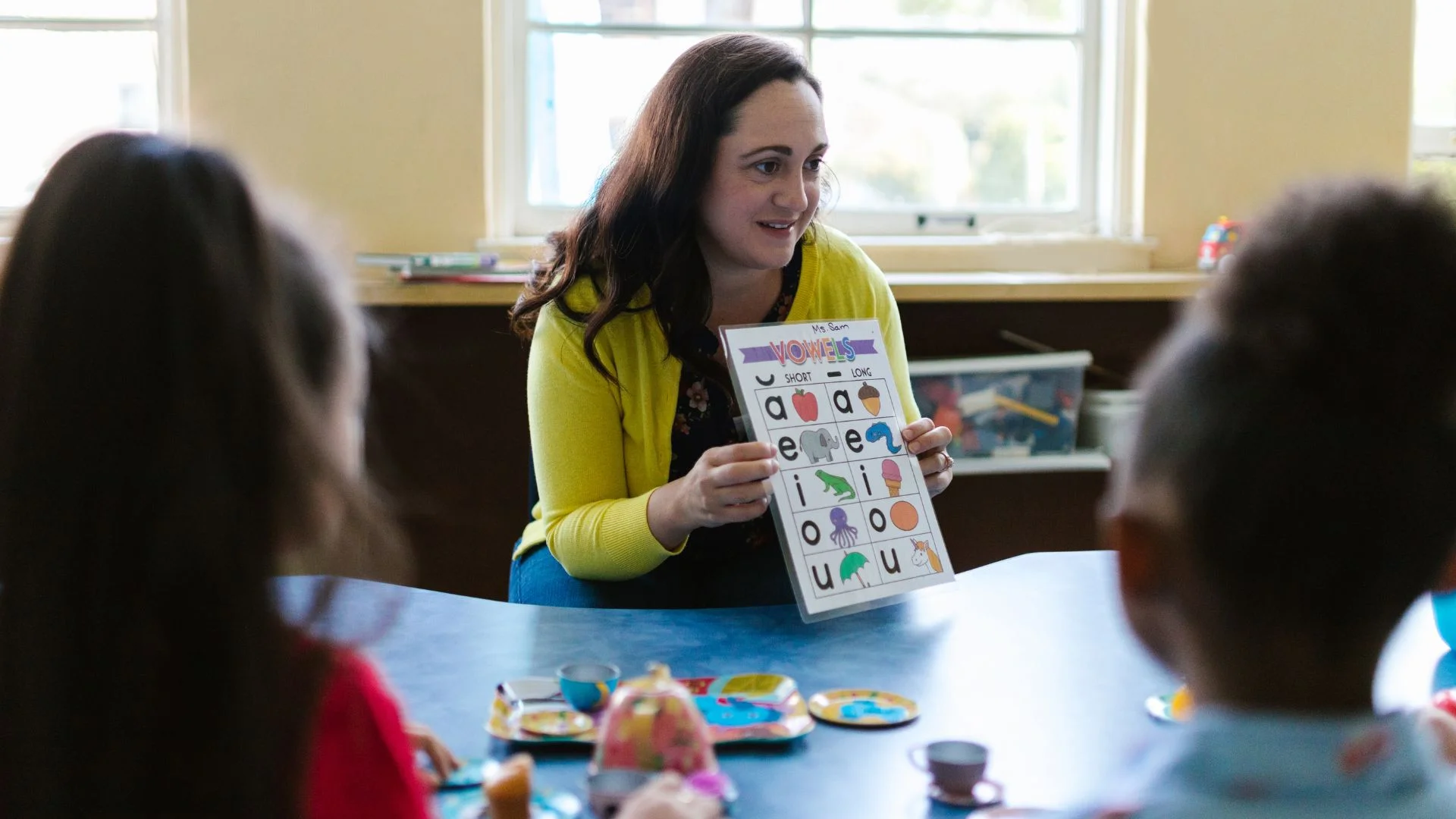
In this blog, you will learn:
- What is phase 1 phonics?
- The importance of phonics.
- What the seven aspects of phase 1 phonics are.
- Discover more about our education recruitment services.
Children begin developing language skills long before they speak their first words. They listen to the voices around them and develop a natural curiosity about sounds.
Phase 1 phonics is the first step in a child’s journey to reading and developing strong speaking and listening skills. It encourages children to explore sounds, verbalise words and engage in playful sound activities that help them notice and remember the sounds they hear.
In our latest blog, discover everything you need to know about phase 1 phonics and how educators can support children in building early literacy skills.
What is phonics and why is it important?
Phonics is a method for teaching reading and writing that helps children understand how letters and groups of letters link to sounds and spelling patterns.
Phonics develops a learner’s ability to connect speech sounds (phonemes) with letters or groups of letters (graphemes). Phonics is crucial to reading success and enables children to decode and encode words to improve both their reading accuracy and fluency.
Decoding words allows children to focus on comprehension, whereas encoding words helps children understand which letters to use when writing. This enables children to spell with greater confidence and apply their phonics knowledge independently, making it an important lesson for all learners.
What is phase 1 phonics?
The Department for Education's Letters and Sounds framework has six distinct phases of phonics and is widely used to teach early reading. These phases are designed to take children from learning to actively listen to sounds in phase 1, to becoming fluent readers and spellers in phase 6.
Throughout these phases, children gradually build their awareness of different sounds and the groups of letters used to represent them.
Phase 1 phonics focuses on listening skills, phonological awareness and oral blending through seven aspects of sound. It is designed for children in nursery and focuses on exposing children to environmental, instrumental and vocal sounds. This enables children to identify, blend and segment sounds orally before matching them to letters.
What does phase 1 phonics focus on?
Phase 1 phonics focuses on:
- Tuning in to everyday sounds, such as rustling leaves or running water, to improve focus and sound awareness.
- Hearing patterns in speech, such as alliteration, to make phrases more impactful and easier to remember.
- Playing with the rhythm, rhyme and the flow of language.
- Blending and segmenting spoken words. For example, Teachers may separate sounds for a child to blend them together and reconstruct the correct word. This can strengthen a child’s ability to recognise the structure of spoken language.
What are the seven aspects of phase 1 phonics?
There are seven aspects of phase 1 phonics, which together lay the foundations for early reading and writing. These aspects develop children’s listening skills and phonological awareness.
Each aspect focuses on a different element of Auditory Discrimination (AD), which describes the ability to recognise and differentiate variations in sounds, syllables and words.
In practice, these aspects naturally overlap and can be taught flexibly through play and everyday experiences. This makes teaching more enjoyable for children and avoids rigid education.
The seven aspects of phonics phase 1 are:
- Environmental sounds.
- Instrumental sounds.
- Body percussion.
- Rhythm and rhyme.
- Alliteration.
- Voice sounds.
- Oral blending and segmenting.
Environmental sounds
Children are first introduced to sound by noticing noises in their environment, such as birds tweeting or a clock ticking. Environmental sounds are an essential part of listening development because they occur constantly, help children understand the world around them and often signal that something specific is happening. For example, the sound of a door opening signals a person’s arrival or departure.
Educators can develop children’s awareness of environmental sounds by taking them outside to immerse in the outdoor soundscape. This gives children the opportunity to tune into the world outside of their home or school environment and discover why each sound occurs.
To develop children’s awareness of environmental sounds, Teachers can use classroom activities such as matching images to sounds or encouraging children to imitate the sounds they hear around them. Through these activities, children can develop their concentration and their ability to connect sounds to meaning.

Instrumental sounds
The aim of instrumental sounds is to develop children’s awareness of the noises made by instruments and noise makers. Instrumental sounds enhance phonics by improving Auditory Discrimination, as well as strengthening listening skills, rhythm and memory. By playing the drums or tapping a pan with a wooden spoon, children can learn to copy patterns and explore different volumes and pace.
Teachers can aid the development of instrumental sounds by creating a sound guessing game with hidden instruments or setting rhythm patterns for children to repeat.
Body percussion
Body percussion plays an important role in creating sounds, communicating and connecting with others. In this aspect of phase 1 phonics, children are encouraged to use their bodies to create sounds such as clapping, stomping, clicking and patting. The aim is to develop children’s awareness of sounds and rhythms as well as sequences and patterns.
Teachers can start by performing an action such as ‘clap, clap, clap’ and passing the action around the classroom until it returns to them. Children are encouraged to listen and interpret the sound and discuss whether the sound got faster or slower as it passed around the group.
Teachers can also develop children’s awareness of sounds and rhythms through activities like singing songs, action rhymes or listening to music that includes actions and clapping. This is not only enjoyable for children, but familiarises them with a range of music and teaches them when to create sounds.
Rhythm and rhyme
Encouraging children to notice rhythm and rhyme in speech is an effective way to develop speaking and listening skills. Rhythm and rhyme supports reading and speech development by familiarising children with how sounds are combined to create words.
Recognising rhythm and rhyme can help children tune into words that end with the same sound pattern, such as ‘cat,’ ‘hat,’ ‘sat’ and ‘mat.’ Anticipating the next rhyming word, through activities such as rhyming bingo, helps children to understand the syllable structure of words.
Teachers can encourage children to play with rhyming words by giving prompts such as, ‘I know a word that rhymes with dog, it hops in the garden and the word is… frog!’
Alliteration
By aspect 5, children will likely begin to hear letter sounds in speech and recognise alliteration. It is important that children are able to identify words that begin with the same sound, whether it's picking them out in a sentence, or using objects in the classroom.
For example, students can handle objects that begin with the same letter such as a ball, book and a banana, and be encouraged to emphasise the ‘b’ sound that they begin with.
Educators can also encourage children to create alliterative names, sentences and phrases, such as ‘Molly made marvellous muffins’, to keep them engaged. Testing children on their knowledge of objects that start with the same sound can reinforce their understanding and make alliteration fun and memorable, especially when tongue twisters are used.
Repeating the same sound at the start of words can give children an ear for language as well as strengthen their phonological awareness.
Voice sounds
To support speech and language development, it’s important that children understand how voices can be adapted for different purposes.
Voices can change to convey emotions, tone and meaning, as well as represent different characters, accents and cultures. Helping children to notice these changes supports their listening skills and deepens their understanding of spoken language.
Children should be encouraged to copy the environmental sounds they hear, mimic specific sounds with their voices and intentionally adopt a different voice. Impersonating a robot, hissing like a snake or playing a character in a role play situation, can inspire children to experiment creatively with their voices to communicate feelings and intentions.
By modelling changes in pitch, pace and volume during storytelling and play, Teachers help children recognise how vocal expression supports the understanding of social cues.
Teachers can also help children explore different mouth movements such as blowing, sucking, tongue stretching and wiggling to ensure they are able to form sounds correctly.
Children can use mirrors to observe their faces, lips, teeth and tongue as they make different speech sounds and experiment with their voices. This can help reinforce the sounds they are making, improve articulation and boost confidence.
Oral blending and segmenting
The last aspect of phase 1 phonics builds on the previous points and begins to link sound to meaning. Oral blending and segmenting breaks down words to their individual sounds before blending them back together to form a word.
Educators can teach children to spot syllables by clapping each time they hear one. They can then count the number of syllables in different words and match words or objects with the same amount.
To practice oral blending, Teachers can say individual sounds such as ‘b,’ ‘a’ and ‘t’ and ask children to blend them together to make the word ‘bat’. Teachers can also say the whole word and ask children to segment it into separate sounds they hear. For example, when hearing the word ‘bat,’ children should be able to identify the three sounds ‘b,’ ‘a’ and ‘t.’
Oral blending and segmenting can help children develop phonological awareness, laying the foundation for accurate reading and spelling in later phases.
SCG School Insights Report 2025
As specialists in education and SEND recruitment, we work closely with primary, secondary, and SEND schools throughout the UK and are mindful of the challenges that schools and teaching staff are currently facing.
In the School Insights Report 2025, we explore pupil experience and outcomes, key developments impacting the education sector, staffing and workforce trends, and the state of funding and resources in education. Read the SCG School Insights Report 2025 here.
Recruit teaching staff
As a specialist education recruitment agency, we support mainstream and SEND schools with their temporary, permanent and temp-perm staffing needs.
We currently work with hundreds of schools and have exclusive access to some of the best Teachers and Teaching Assistants in the North West.
If you’re struggling to fill a teaching vacancy, why not get in touch with one of our team to see how we can help?
- Primary schools - Jimmy Callagher
- Secondary schools - Liam Jones
- SEND schools - Jamie Heath
Teaching jobs
If you’re searching for your next teaching job, why not take a look at the latest teaching vacancies, or simply upload your CV to be notified when a relevant position becomes available.
Meet Jamie Heath
Who is Spencer Clarke Group?
Established in 2017, we’re an award winning and progressive recruitment agency based in the heart of the North West. Our reputation is built on trust, expertise and an unwavering commitment to exceed expectations.
In 2025, Spencer Clarke Group was awarded Best Public/Third Sector Recruitment Agency and Best Temporary Recruitment Agency at the Recruiter Awards. In 2024, Spencer Clarke Group was also named Recruitment Agency of the Year.
Related Posts

How to Engage Reluctant Readers in School
19 Mar, 2026